“Can I have the envelope, please”

No, not the academy awards. Too early for that. But this post is about the ostrich-like approach 401(k) participants have taken in opening (or rather not opening), their December 31, 2008 statements. Earlier this month, I posted the visual below about participants’ hesitation, Just Get It Over With, from Jessica Hagy’s award winning blog,  Indexed,


That’s a facetious description, of course. But specific and troubling data comes out of a recent survey by I-Pension, LLC, a Newton, MA-based Registered Investment Advisor focused on middle-income investors.

I-Pension surveyed middle-income investors following the 2008 year-end meltdown and found that: 

  • 27% of the respondents admitted to not opening their fourth-quarter 401(k) statements.
  • Of those that did open their statements and read their statements, almost 33%spent less than one minute reviewing the results and 72% spent less than 3 minutes.

Here is I-Pension’s press release that discusses the survey and other findings regarding 401(k) participants’ investment expertise – or lack thereof.  

To paraphrase a pop culture expression, the answer is out there somewhere.

403(b) compliance picture getting clearer

The new 403(b) compliance picture seems to be getting clearer. Much needed light was provided on the new regulations at the February 6, 2009 Tax-Exempt and Government Entities Joint Council Meeting in Baltimore attended by senior IRS officials and tax practitioners.  

Attorney Bob Toth, of counsel at Giller and Calhoun was at that meeting. Bob, you may recall, was a guest contributor to our series of blog posts, the 403(b) Crunch Time Series, to help 403(b) plan sponsors get ready for the January 1, 2009 effective date for the IRS final 403(b) regulations.

We had intended to have the series run until year-end, but only got to #6 before the IRS issued IRS Notice 2009-3 (see Plop plop, fizz fizz, oh what a 403(b) relief it is: IRS Notice 2009-3) that extended the plan document requirement to December 31, 2009.

So now two months into the year, just exactly where are we regarding compliance with the new regulations. Here are some highlights of what the IRS had to say about compliance issues.
Plan sponsors were urged to use the extension of time to have the plan document in place by year-end constructively.

  • Plan sponsors should adhere to the principles of universal availability and non-discrimination, and to retroactively correct and operational mistakes prior to December 31, 2009.
  • While the voluntary correction program under Revenue Procedure, 2008-50 does not include specific correction procedures for 403(b) plan documents, a future release will include such procedures. In the meantime, Section 6 should be reviewed for the general principles of restoring appropriate benefits to participants who did not receive them during the year. 
  • A revenue procedure is being drafted to create a determination letter program and prototype program for pre-approved Section 403(b) plans.

The tax practitioners had observations about some unresolved issues and how to resolve them. Bob Toth who was at this meeting commented that

  • More guidance is required from the Department of Labor to determine when a 403(b) plan is covered by Title I of ERISA which generally governs disclosure, reporting, and fiduciary aspects of retirement plans.
  • Employers should be very careful of adopting 401(k) language for a 403(b) plan since the operating rules are different and could inadvertently cause the plan to be covered under ERISA.

The compliance picture isn’t exactly hi-def yet, but then we don’t need rabbit ears either.

Independent contractor or employee? Employee classification still a high priority enforcement matter

Remember that kids’ game, Animal, Vegetable, or Mineral? You had to guess into what category the object fell. Well, today in business, there is a similar question. Independent contractor or employee?

But it’s not a game. The misclassification of a worker can have serious financial consequences. Penalties and interest involving payroll taxes can pile up if someone is incorrectly treated as an independent contractor. And in the case of a retirement plan, the employer would have to make up the benefits the individual would have received.

It’s an issue that we are particularly sensitive to with our clients at this time of year as we start to receive employee census data for 401(k) discrimination testing. One of the questions we ask is "Do you have any independent contractors?" A "yes" response initiates a discussion that the employer have a process in place that the independent contractor classification will hold up in the event of an audit.

Rush Nigut, a West Des Moines, Iowa-based attorney also has an on-going concern about the classification issue and has written about the subject. His recent post on his blog, Rush on Business, State of Iowa to Step Up Contractor Misclassification Efforts, also include links to other information on the matter. It is anticipated, Rush said, that these enforcement efforts could bring in millions in additional revenues to the state.

But it’s not just the State of Iowa or other states for that matter, the Internal Revenue Service, of course, also has a keen interest in proper classification of workers. Just last month, the IRS updated their on-line resource page, Independent Contractor (Self-Employed) or Employee? The page includes links to how to get a determination from the IRS on a worker’s status and how to get tax relief.

And for any complicated tax matter like this one that can be a potentially costly tax miscue, consult a qualified tax advisor. This is another one of those "kids, don’t try this at home" matters.

Picture credit: Animal, Vegetable, or Mineral?, by Michael Cook. Installation: each unit 4ft., x 4ft., overall dimensions 8ft. 6in. x 8ft. 6in. for each group of four, Museum of Fine Arts, Santa Fe, 1990. 

Department of Labor sponsoring fiduciary compliance assistance seminar for small businesses

Unless you’ve been asleep, compliance with fiduciary responsibilities is one of the highest priorities of the U.S. Department of Labor (DOL).

And if you’re a small employer, it can be a difficult and challenging assignment to be responsible for a retirement plan. But here’s some help.

The DOL will be sponsoring a free seminar in Chicago on June 24 and in Atlanta on July 9: A Retirement Plan Compliance Assistance Seminar for Small Business.

Representatives from both the DOL and Internal Revenue Service will discuss fiduciary responsibilities, reporting and disclosure requirements, common mistakes and how to fix them.

Here are links to the seminar brochure and registration information for each location:

For Chicago on June 24 and for Atlanta on July 9.

If you’re a local plan sponsor in either of these areas, attendance could be very worthwhile.

“Performance Persistance in Entrepreneurship”

Over at Slate’s BizBox blog, a special promotion by Open from American Express, I posted an article about new research in a just-published working paper by the Harvard Business School. The article, "Performance Persistence in Entrepreneurship", appeared in the Harvard Business School’s Working Knowledge Newsletter.  Check out Persistance and Experience Pay Off.

“Just get it over with.”

Last week in a blog post about self-directed brokerage accounts, I wrote about participants just starting to open their year-end 401(k) statements with some (or much) hesitation. But here’s Jessica Hagy in her award winning blog,  Indexed, whose picture, Just get it over with, is far more effective than my words about hesitating to get the bad news.

First online 401(k) rating system launched by BrightScope, Inc.

Transparency has several meanings.

In optics, transparency is the material property of allowing light to pass through.

When used in a social context, transparency implies openness, communication, and accountability.

In the 401(k) industry, transparency means fee disclosure. And, of course, it’s what Congress and the Department of Labor have been focusing on over the last few years.

But it may be the private sector that puts transparency into a very practical setting. BrightScope, Inc., an independent data analytics firm today announced the launch of their 401k ratings disclosure website featuring the BrightScope Rating™, the nation’s first online 401(k) rating system.

The new BrightScope Rating™ debuted today (see Press Release) at the 2009 Los Angeles Benefits Conference, co-sponsored by the Internal Revenue Service (IRS), the American Society of Pension Professionals & Actuaries (ASPPA) and the National Institute of Pension Administrators (NIPA).

What’s a BrightScope Rating™? It’s a quantitative 401(k) plan rating developed by BrightScope, Inc. in partnership with some of the country’s top independent fiduciaries, finance professors, and 401(k) experts. BrightScope Ratings™ take into account over 200 unique data inputs per plan and calculate a single numerical score to define 401k plan quality at the company level.

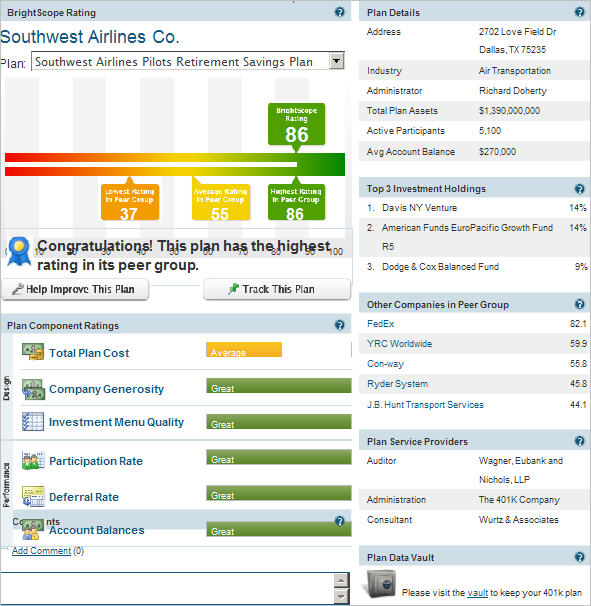
For example, BrightScope currently rates the 401(k) Plan for the Southwest Airlines Pilots as among the top plans within its respective peer group, as measured in terms of plan size, number of participants and employee demographics.

Participants contributing to this plan, BrightScope says, have a high likelihood of having a secure retirement.

The picture below is a snapshot of what you would see on the BrightScope website for the Southwest Airlines plan.

The complete rating can be viewed by clicking here.

You can see detailed scores and attributes for the other approximate 1000 of the largest 401(k) plans that BrightScope has reviewed to date by visiting their website, www.brightscope.com with more plan ratings available later this year.

As for me, I’m still thinking about the implications of this innovation. Could be huge. 

Which type of employer are you?

Over at Slate’s BizBox blog, a special promotion by Open from American Express, I posted an article about new research that MetLife recently unveiled regarding the four key types that employers embody when it comes to workplace benefits investments and strategies. Check out Thinking Critically About Your Benefit Package.

Self-directed brokerage accounts: deja vu all over again?

Jackson PollackJust about now, 401(k) participants are starting to open their year-end statements. Some because they’re just starting to receive them, others because they’ve decided it’s now time to confront the harsh reality of substantially diminished account balances.

That is, if they haven’t already gone on-line (how many times?) the last quarter. But, of course, the piece of paper in their hands makes it official.

And so what you may start to see again – and we already have – is 401(k) participants saying, “hey, I can do a better job than this” and wanting to manage their accounts themselves in what the retirement industry calls “self-directed brokerage accounts” or SDBAs. These individual accounts are established and maintained either on a stand-alone basis or through the 401(k) provider handling the menu of funds.

SDBAs were popular back in the days of irrational exuberance when 401(k) participants wanted to go beyond the limitations of the fund menu. The driving force was usually a business owner or important Highly Compensated Employee with a large account balance. And so while there are many reasons not to have SDBAs as part of a 401(k) plan, those participants with clout may cause is to happen in today’s investment climate.

In that case, it’s incumbent on the plan sponsor to structure a program that deals with such concerns as

  • Fiduciary liability for improper investment transactions
  • Unrelated business taxable income (UBTI)
  • Administrative and investment expenses
  • Valuation

All of which can be dealt with proper planning and execution. The starting point for which is the Investment Policy Statement. You do have one, don’t you?

Photo above, deja vu, by pngn via Flickr.

You are who your clients are

This one goes out to all the business owners who provide either personal or business services – present company included. Over at Slate’s BizBox blog, a special promotion by Open from American Express, I posted an article that says why not have clients who you enjoy, are not toxic, and reflect your values. Check out You Are Who Your Clients Are.

LexBlog